





Watch
Indonesia has an estimated 3,294 GW of solar potential, yet only about 1.49 GW of solar capacity was installed by the end of 2025. On 25 August 2026, the government launched its 100 GWp Solar Power Program to close that gap. Every gigawatt will need glass, cells, modules, cables and storage, and much of it must be made locally. Inside the Java Integrated Industrial and Port Estate (JIIPE), Gresik Special Economic Zone (SEZ), the first layer of that supply chain is already running.
The material layer is already here
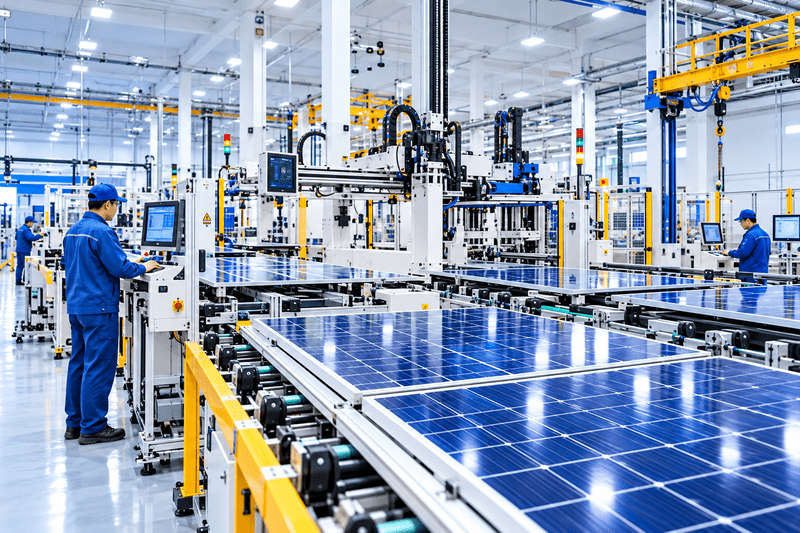
On 15 January 2026, Xinyi Solar lit its first photovoltaic glass furnace in Indonesia at JIIPE. The line uses ultra-clear rolled glass technology, melts 1,200 tonnes per day and produces more than 360,000 tonnes of PV glass a year. That is enough glass for about 8 GW of solar modules annually.
The Xinyi group has committed land on both sides of the business: 38 hectares for Xinyi Glass and 61 hectares for Xinyi Solar. In the first half of 2026, Xinyi Solar's capital spending went mainly to the Indonesian project. Even with solar glass prices under pressure in China, the company says it will favor overseas glass expansion.
Demand: two plans, one direction
Indonesia's two main power plans both put solar at the center.
- RUPTL 2025–2034 (PLN's electricity plan): 69.5 GW of new capacity, including 42.6 GW of renewables and 10.3 GW of storage. Solar is the largest renewable source at 17.1 GW.
- 100 GWp Solar Power Program: launched in August 2026 with a three-year target of about 33 GWp a year. Around 80% is planned as village solar with storage, and about 20 GW as utility-scale plants.
The first tender pipeline of 4.7 GWp includes the 1,688 MWp Jatiluhur and 1,250 MWp Cirata floating solar projects. The Java-Madura-Bali grid, where JIIPE sits, accounts for 19.6 GW of planned renewables in the RUPTL, including 10.9 GW of solar.
The gap: manufacturing has not caught up
Indonesia's energy ministry counts 34 domestic module manufacturers with combined capacity of about 10.9 GW a year. Their local content (TKDN) level ranges from 40% to 55%. Industry players point to limited upstream capacity in polysilicon and wafers and heavy reliance on imported components.
Local content now carries a price. SMM analysis puts Indonesian TOPCon modules at about US$0.130/W with 25% TKDN, US$0.150/W at 40% and about US$0.185/W above 40%. Glass, frames and cells all count toward TKDN, so each local component a manufacturer adds can strengthen its position in government tenders.
What can be built next to the glass
With PV glass produced inside the estate, JIIPE is a natural site for the next layers:
- Solar cell and module assembly using locally made glass to lift TKDN
- Aluminium frames, junction boxes, EVA film and backsheets
- PV cable and ribbon, using copper cathode from the Freeport smelter in the same estate
- Silver paste for cell metallization, close to Freeport's precious metal refinery
- Inverters and battery energy storage systems (BESS) for the program's village and grid projects
The JIIPE solar value chain at a glance
|
Layer |
Status at JIIPE |
Investment opening |
|---|---|---|
|
PV glass |
Xinyi Solar furnace operating since January 2026, ~8 GW/year equivalent |
Second-line expansion, coated and back glass |
|
Metals |
Freeport copper smelter and precious metal refinery in the estate |
PV cable, ribbon, silver paste |
|
Cells and modules |
Open |
Cell and module lines targeting high TKDN |
|
Components |
Open |
Frames, junction boxes, EVA, backsheets |
|
Storage and power electronics |
Open |
BESS assembly, inverters |
Why build at JIIPE
- PV glass, copper and silver produced inside one integrated estate
- Located in Java-Madura-Bali, the largest solar build-out region in the RUPTL
- Deep-sea port for importing equipment and exporting to Southeast Asia
- Gresik SEZ incentives, with immigration services and a customs auto-gate system on site
Frequently asked questions
Is solar glass already produced in JIIPE? Yes. Xinyi Solar's furnace has operated since January 2026 with more than 360,000 tonnes of annual output.
Why does local content matter? TKDN rules shape procurement in Indonesia's 100 GWp program. Modules with higher local content qualify for more projects.
How big is the domestic market? The RUPTL plans 17.1 GW of new solar by 2034, and the 100 GWp program targets about 33 GWp a year over three years.
The glass is already being made. Talk to the JIIPE team about land, utilities and SEZ incentives for the cell, module, component or storage plant that comes next.